DRAFT
Playbook for SRS Information Technology (IT)
Choosing appropriate hardware and software is crucial for ensuring a sample registration system (SRS) functions effectively. This section describes the information technology needs and decision-making factors for building SRS information systems. Given the rapidly progressing innovations in digital solutions, a careful review of the state of the art is always necessary for the choice of an appropriate digital and information technology architecture.
With rapidly improving digital technology for data collection, analysis, and dissemination, a SRS must incorporate up to date technology to ensure rapid data collection and transfer, real-time access and monitoring, analysis and release. This will require involving from the outset IT technicians and engineers. The choice of hardware and software must be guided by the overall objectives of the SRS and the IT capacity—both human resources and technical resources— in the country.
Critical factors in decision-making related to hardware and software include:
- Meeting the basic requirements in these areas
- offline systems
- capture of longitudinal data
- multilingual display
- ease of use by community-based staff who may need to work offline
- broad requirements related to accessibility, adaptability, scalability, and security
- Cost
- Reliability and maturity
- Alignment with team member skills and experience
Goal of this playbook
The overarching goal of the IT Playbook is to equip countries with clear, practical, and accessible IT guidance that supports the successful design, launch, and sustainability of SRS. To achieve this goal, the Playbook will pursue the following objectives:
- Identify core IT concepts that underpin SRS operations
- For each core IT concept, provide three key pieces of information to support country decisionmaking in planning SRS IT:
- Describe and define, in broad terms, the processes, procedures, and goals that apply to this concept
- Detail relevant tools or software
- Highlight country experiences
After using this Playbook, users from Country X should be equipped to ask and answer the following questions with their SRS teams:
- Which steps of the SRS process are supported by IT tools that Country X needs to support, whether by standing up an existing tool or modifying a system to fit the purpose?
- What system-focused IT design decisions does Country X need to make or clarify with organizational stakeholders?
- How does Country X operationalize this process? Specifically, in what order should Country X plan things and how does Country X estimate the work?
- How have other countries done this?
Intended Audience
What type of country should use this playbook?
The IT Playbook is aimed at a country in the late stages of planning or early stages of implementation of a SRS. It is most useful for a country that has completed situational assessment and is in the SRS design phase – where country stakeholders are determining what specific parts of SRS will be implemented and how that implementation will occur.
Who in that country should use this playbook?
The IT Playbook is most appropriate for members of a country’s IT team who have experience with the core IT concepts. This playbook aims to give those IT staff information about how SRS IT is intended to function, equipping them to advise the larger SRS program teams on IT-specific decisions. As opposed to the larger VIVA resources on this site that are aimed at programmatic stakeholders in SRS, this section (constituting the Playbook) is intended for the audience of system architects, software engineers, programmers, and data managers who are tasked with building and running the system.
Structural Framework
The following subsections detail the core concepts underpinning SRS operations, attempting to map those core concepts to steps of the SRS process. Then, this section discusses and defines the four types of information that will be provided for each core IT concept.
Core IT concepts underpinning SRS operations
Six core IT concepts underpin all SRS operations. While many of them are not dependent on each other and therefore can be worked in parallel, the ordering shown below is intended to help prioritize. SRS IT teams typically have limited staff who cannot work on items in parallel, and developing and SRS IT solutions in this order is recommended best practice in such a situation. Additionally, a job title is highlighted to indicate the person best qualified to lead the effort. These areas all require collaboration with other team members, but the title listed is meant to identify the core skillset(s) of the person best positioned to lead the task.
The IT playbook is organized with a section for each of these six core IT concepts, with an Appendix that follows detailing miscellaneous tools and IT sustainability.
- Infrastructure and databases (System Administrator; Programmer)
- Creation of the electronic forms (Data Manager)
- Case Management (Programmer)
- Operational Reporting (Data Manager; Programmer)
- Data Science (Data Manager; Statistician)
- System Compatibility, Integration, & Interoperability (Programmer; Data Manager)
SRS development timeline
The following table illustrates a possible development timeline, organized by the six core concepts described above. This timeline follows the prioritization highlighted above, with Infrastructure being worked first and Data Exchange being worked last. This timeline might not apply to every SRS program; however, it can be a starting point. 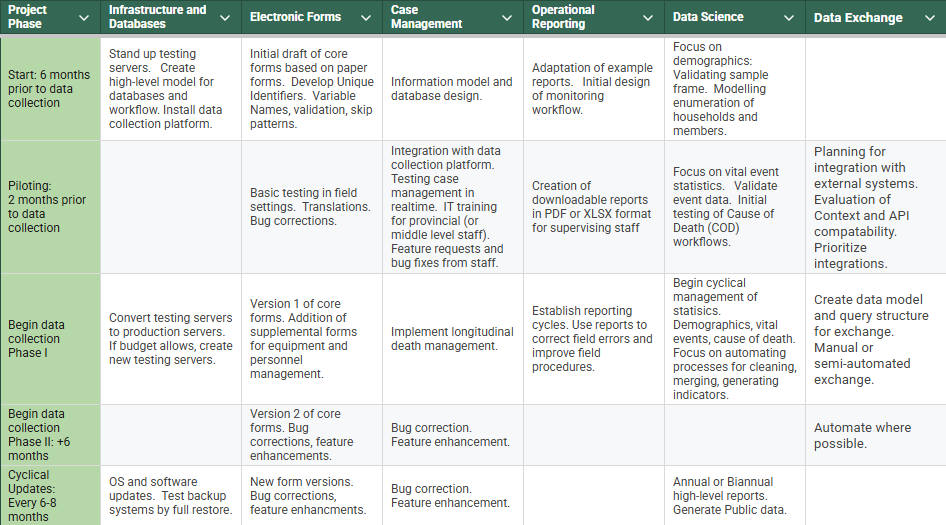
Four types of information that constitute the Playbook
Each section covering a core IT concept strives to follow a common structural framework, to enable easy searching for information and comparison across sections:
Guide
A Guide is a succinct overview description of the specific step or IT process. What does the IT process seek to accomplish? How does that IT process fit into the larger SRS workflow? How might this IT process map to existing frameworks or steps such as the already-released IT checklist? This section should be written in plain language whenever possible and, while aimed at a member of the IT team, content should mostly be understandable to someone with a limited IT background.
Tools
Tools are products that have already been developed by previous SRS programs that could aid in the implementation of the content described in the Guide. Some tools may be nontechnical artifacts – workshop materials and user persona definition worksheets would also be described within this category. Technical Tools are distinct from Software (see next section) in that Tools are not executable programs; rather, they require some level of manual work to run and configure. For example, sample R code to analyze causes of death or an XLSForm questionnaire specification to gather birth outcome information from a reported event would be considered a Tool.
Software
Software is an executable program that can be used to accomplish the relevant steps in the Guide. Some software will be SRS-customized and specific (such as Verbal Autopsy Explorer [VAE] or the SRS Case Management System [CMS]). Other software will be open-source recommendations to accomplish certain steps. Software could relate directly to tools; for example, R and an OpenDataKit (ODK)-supported database such as ODK Central or Kobo Toolbox will be recommended software for the example tools described above (sample R code and an XLSForm questionnaire, respectively).
Stories
All content described in Guides, Tools, and Software describes the recommended path towards accomplishing that specific SRS process or step. However, countries may follow a different path that should be highlighted. Stories seek to capture exactly that – did Mozambique do something particularly interesting related to this step? Zambia? Sierra Leone? India?
| Last updated |
|---|
| 23 October 2025 |
| Portions of this page are © 2025 The MITRE Corporation. All rights reserved. Approved for Public Release #25-2779. Distribution Unlimited. The source of this information is the Technical Assistance for Sample Registration Systems (SRS) Planning Grants, a joint project of the CDC Foundation and Swiss Tropical and Public Health Institute through the Gates Foundation SRS Grant. |